
Sanding Engineered Oak Floors in Carshalton Extensions
If your rear extension or open-plan kitchen has engineered oak flooring that now looks scratched, dull or uneven, professional restoration is often the most cost-effective way to bring it back to life. At Carshalton Floor Sanding, we regularly restore timber floors across local homes using dust-controlled sanding systems, repairs, and modern hard-wearing finishes suited to real family use. Many properties in and around Carshalton combine older house layouts with newer extensions, which means the flooring often has to cope with changing light levels, underfloor heating, patio doors, kitchen traffic and seasonal moisture shifts all in one connected space.
That combination is exactly why engineered oak floor restoration needs a more careful approach than a standard solid timber resand. In a rear extension, the boards may look robust on the surface, but the wear layer thickness, subfloor condition, adhesive bond, thresholds and movement joints all need checking before any machine touches the floor. Done properly, sanding engineered oak can remove surface wear, flatten out minor lipping, improve colour consistency and prepare the timber for a fresh protective finish. Done badly, it can cut through the top veneer and leave an expensive problem behind.
In this guide, we’ll explain how engineered oak floor sanding works in Carshalton extensions, when restoration is possible, what technical checks matter most, and how to choose the right finish for a modern family home. We’ll also cover the typical issues we see in extension floors, from sunlight fade near bifold doors to movement around kitchen islands and heavy traffic lanes between dining and garden areas.
Why engineered oak floors in Carshalton extensions wear differently
Engineered oak is popular in extensions for good reason. It gives the look of real oak while offering better dimensional stability than many solid boards, especially in spaces with large glazing, changing humidity and underfloor heating. Even so, extension rooms put engineered boards under real pressure. South-facing glass, frequent garden access, grit from shoes, pet traffic, dining chairs, island stools and cleaning moisture all work on the finish day after day.
In Carshalton, many homes also combine an older property with a more contemporary kitchen-diner extension. That means one connected floor may cross from an original part of the house into a newer slab or subfloor build-up. Where installation standards were only average, that can lead to slight height variation, movement noise, perimeter stress or accelerated finish wear in the brightest and busiest zones. Our live service pages already emphasise dust-controlled sanding, repairs, staining and oil or lacquer finishing as part of the local restoration offer, which aligns closely with what engineered extension floors need when they start showing age.
Can engineered oak floors actually be sanded?
Yes, many engineered oak floors can be sanded, but not all of them should be. The critical factor is the thickness of the real oak wear layer. A proper inspection needs to establish whether the top layer is thick enough to allow safe sanding without exposing the core beneath. That is why a specialist survey always comes first.
On the Carshalton site’s existing wood floor sanding content, the company already notes that solid and engineered hardwood floors can respond very well to professional sanding and refinishing. It also highlights an important technical truth elsewhere on the site: engineered floors can only be sanded a limited number of times, whereas solid timber offers more flexibility.
In practice, a responsible contractor will assess:
- Wear layer depth
- Board condition and previous sanding history
- Any cupping, crowning or edge damage
- Subfloor stability and movement
- Adhesive integrity on glued installations
- Moisture levels in both timber and subfloor
- Whether underfloor heating is present
That inspection stage matters because extension floors often look as though they simply need “a quick sand”, when the real cause of the problem may be moisture imbalance, movement, failed expansion detailing or an incompatible cleaning routine.
Common problems we see in engineered oak extension floors
1. Finish wear around bifold or patio doors
Garden-facing doors create the classic traffic lane. Fine grit, moisture and direct sunlight gradually thin the finish, leaving the oak looking dry, pale or patchy. Once the coating is compromised, the floor marks more easily and routine cleaning becomes less effective.
2. Scratches around kitchen islands and dining zones
Chair movement, footfall, dropped utensils and pet claws can all leave the surface looking tired long before the floor itself is structurally worn out. This is especially common in extensions where the kitchen, dining and family room all share the same floor area.
3. Slight lipping or uneven reflection across boards
Where temperature and humidity fluctuate, some boards may move very slightly, creating a visible change in reflected light. A careful sanding sequence can often refine the surface, provided the wear layer allows it.
4. Dullness from poor maintenance products
Many homeowners unknowingly use general-purpose floor cleaners that leave residues, soften certain finishes or create a cloudy appearance. This can make engineered oak look older than it really is.
5. Movement near thresholds
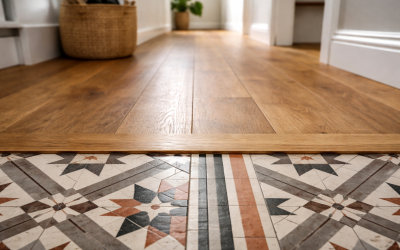
Where an extension meets an older part of the house, there may be changes in subfloor build-up, expansion behaviour or past installation quality. Those transition points need to be checked carefully before restoration starts.
Why moisture-content mapping matters before sanding
One of the biggest mistakes in extension restoration is treating every worn floor as a purely cosmetic problem. In reality, timber performance always relates to moisture and environment. Before sanding an engineered oak extension floor, it is sensible to carry out moisture-content mapping and inspect the broader room conditions.
This is particularly important if the room has underfloor heating, large areas of glazing or a history of condensation near doors. Modern coating systems also require the floor to be acclimatised, dry and free from contamination before application. Bona’s current technical data for Traffic HD states that the floor should be acclimatised to its end-use environment, well sanded, dry, and used under roughly 18–25°C and 30–60% relative humidity. Osmo’s current Polyx-Oil product information likewise notes that higher humidity and lower temperatures can significantly increase drying times.
In plain terms, that means a proper contractor should not just arrive, sand, coat and leave. They should be looking at the room as a working environment. If the extension is too damp, too cool or fluctuating heavily, the finish performance and long-term result can suffer.
Our step-by-step approach to extension floor restoration
Initial survey and technical assessment
Every successful engineered floor restoration starts with inspection, not assumptions. We check board construction, likely wear layer depth, movement, visible damage, thresholds, previous finishes and any signs of moisture-related stress. If the floor is suitable for sanding, we then plan the least aggressive process that still achieves a clean, even result.
Room preparation and protection
Extension rooms often contain kitchen units, glazed doors, skirtings, island legs and fitted joinery that need careful masking and protection. Good preparation keeps the finish crisp and avoids damage to surrounding surfaces.
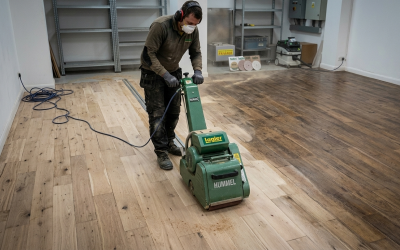
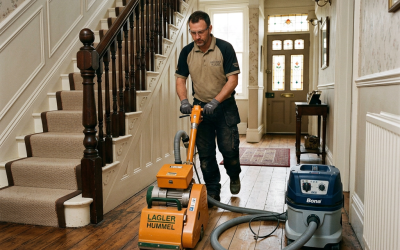
Dust-controlled sanding
The Carshalton site’s own wood floor sanding content explains that “dust-free” really means high-efficiency dust control rather than literally zero dust, using modern machines with effective extraction. That is exactly the right expectation to set. The goal is a clean, controlled sanding environment with dramatically reduced airborne dust compared with older methods.
For engineered oak, the sanding approach must stay conservative. We are not trying to remove unnecessary timber. We are refining the top surface, removing the old finish, reducing wear marks and preparing the floor evenly for coating. Depending on condition, that may involve a carefully managed grit sequence such as 40, 60, 80 and 100/120, or a lighter refinement where the veneer thickness demands extra caution.
Repairs, filling and detail work
If there are local defects, minor edge damage, small gaps or trim issues, these are addressed before the final sanding passes. Not every engineered floor should be heavily gap-filled, especially where seasonal movement is part of the floor’s behaviour, but selective filling can improve appearance where appropriate.
Vacuuming and contamination control
Before finishing, the floor must be meticulously vacuumed and checked for residues, oils, silicone contamination or cleaning-product build-up. This stage is one of the quiet secrets behind a better final coat.
Sealing and finishing
The right finish depends on the household, the look you want and the way the extension is used. On the Carshalton site’s commercial floor sanding article, the business already points readers toward durable modern coatings and notes that engineered boards need finite, careful handling.
Best finish options for engineered oak in a Carshalton extension
Water-based lacquer for busy family life
If you want a durable, low-maintenance finish for a kitchen-diner extension, a high-grade water-based lacquer is often the strongest all-round choice. Bona Traffic HD is a well-known professional option. Bona’s latest technical literature states a drying time of roughly 2–3 hours between coats under suitable conditions, with about 80% cure after 24 hours, although temperature and humidity affect that timeline.
That makes it a strong candidate for households that want:
- High wear resistance
- Simple routine cleaning
- A tidy satin, matt or extra-matt appearance
- Strong performance in kitchen-family spaces
Hardwax oil for a natural, repairable look
If you prefer a more natural, low-sheen appearance that keeps the oak looking warm and tactile, hardwax oil can be an excellent option. Osmo Polyx-Oil Original is designed for flooring and, according to current product information, typically dries in around 8–10 hours for clear coats under normal conditions, with higher humidity extending the process.
Hardwax oil often suits homeowners who want:
- A more natural oak look
- Localised repairability in the future
- A softer, more understated finish character
- Easy refresh options in traffic zones
The trade-off is that oiled floors usually need more maintenance awareness than a high-performance lacquered floor. That does not make them worse, only different. The right choice depends on how you live.
How extension layout affects the restoration strategy
Rear extensions in Carshalton are not all the same. Some are compact side-return kitchens. Others are full-width family rooms opening onto the garden. The restoration plan should reflect that.
For example:
- In a narrow galley-style extension, traffic patterns are concentrated, so finish durability matters more.
- In a large open-plan room with sliding doors, UV shift and moisture tracking often become the bigger issue.
- With underfloor heating, coating selection and environmental stability are especially important.
- Where the extension joins an older timber-floored room, tone matching and transition detailing need extra care.
That is why a local, inspection-led service matters more than a generic quote over the phone.
Why professional restoration is better than replacement in many cases
Homeowners often assume that once engineered oak looks worn, replacement is the only answer. In many cases, that is simply not true. If the wear layer is sound and the boards are stable, restoration can preserve the real oak surface you already paid for, avoid the disruption of ripping out the floor, and deliver a cleaner, more bespoke finish result.
It also allows you to correct the look of the room. Maybe the original finish is too glossy for the extension. Maybe it looks too orange in afternoon light. Maybe the wear near the doors makes the whole room feel tired. A restoration project lets you recalibrate the floor to suit how the space is used today.
For broader background on local restoration work, you can also explore our guides to wood floor sanding in Carshalton, wood floor sanding and restoration, and commercial floor sanding in Carshalton. Those pages reflect the same dust-controlled approach, repair-first mindset and finish-led thinking used across local timber floor projects.
Aftercare for a newly restored engineered oak extension floor
Once the floor has been restored, the next priority is protecting the result.
- Use felt pads under dining chairs and stools.
- Control grit at garden doors with quality entrance matting.
- Avoid soaking the floor during cleaning.
- Use the cleaner recommended for the finish system applied.
- Keep indoor conditions reasonably stable, especially with underfloor heating.
- Lift rather than drag furniture.
- Deal with spills promptly around kitchen and dining areas.
Good aftercare is what separates a floor that looks superb for years from one that starts ageing too fast in the first busy season after restoration.
Final thoughts: restoring engineered oak properly in Carshalton
Sanding engineered oak floors in a Carshalton extension is absolutely possible in many cases, but it is not a job for guesswork. The wear layer has to be respected, the room conditions have to be understood, and the finish choice has to match the way the extension actually functions. When those details are handled properly, a tired extension floor can be transformed into one of the strongest visual features in the home again.
If your extension floor is scratched, dull, patchy or beginning to feel dated, visit carshaltonfloorsanding.co.uk to arrange an assessment. We can inspect the floor, confirm whether sanding is viable, recommend the best finish for your household, and restore the oak surface with a dust-controlled, detail-led process designed for long-term results. For finish guidance from a major manufacturer, you can also review Bona Traffic HD technical information before deciding on your preferred protection system.